
For most of my life, consciousness was simple. It shared the root of words like unconscious, self-conscious, consciously, etc, each with a well understood meaning. It turns out that consciousness is so much more than a byproduct of brain activity. It's also more than another word for soul.
Growing up in a 1980s, Midwest, Christian environment, I learned we're souls temporarily housed in bodies, destined for heaven or hell based on a personal belief. Your body is sacred, divinely designed, and one-time use.
That framework progresses into broader materialism, regardless of theistic beliefs. As far as consciousness, it's just what brains do—neurons firing in patterns that produce the sensation of being you. The physical world is source and truth. What we see, hear, feel, and measure is our reality. Creationists and atheists largely agree that consciousness is a byproduct of our biology. An individual, localized, alternate word for awareness.
Frameworks limited to soul or neurology felt too small, while maintaining a hyper-confident sense of correctness. Something's been stirring lately to push past both of these and see where it leads.
I started where most in their curiosity phase do. Books, podcasts, movies, lectures, and frameworks that felt permission-granting.
In the early 2000's, I married into a family of mental health experts and became a true believer in therapy after decades of going through it myself. Around 2020, I discovered IFS therapy1—Internal Family Systems, developed at Harvard and now backed by substantial clinical research. The approach involves finding your true, centered self, then connecting with and healing the various parts of you shaped by struggle and trauma. It can be wildly effective. (But if consciousness is just neurons, how does addressing "parts" of yourself with intention produce measurable change?)
Then I started reading the likes of Richard Rohr2 and Michael Singer,3 learning about the ego as a construct rather than identity. Johns Hopkins Center for Psychedelic Research4 followed—one of the world's leading programs conducting FDA-approved clinical trials on psilocybin and consciousness, publishing results in top-tier medical journals. The research suggested that reducing ego activity through psychedelics allowed participants to access something beyond their default sense of self.
Then Ky Dickens released The Telepathy Tapes5—a podcast documenting cases of nonverbal autistic children communicating with parents and teachers in ways that shouldn't be possible. Transparent, documented (though unverified), anecdotal, and highly compelling. The kind of thing a materialist would dismiss immediately and an Evangelical would call sorcery and run away. Thankfully, I went deeper. (side note: with two seasons out now, run—don't walk— to listen)
This is where permission lives. In the accessible entry points that suggest maybe, possibly, the story is bigger than we were told. It only feels scary because we've been trapped inside a bubble.
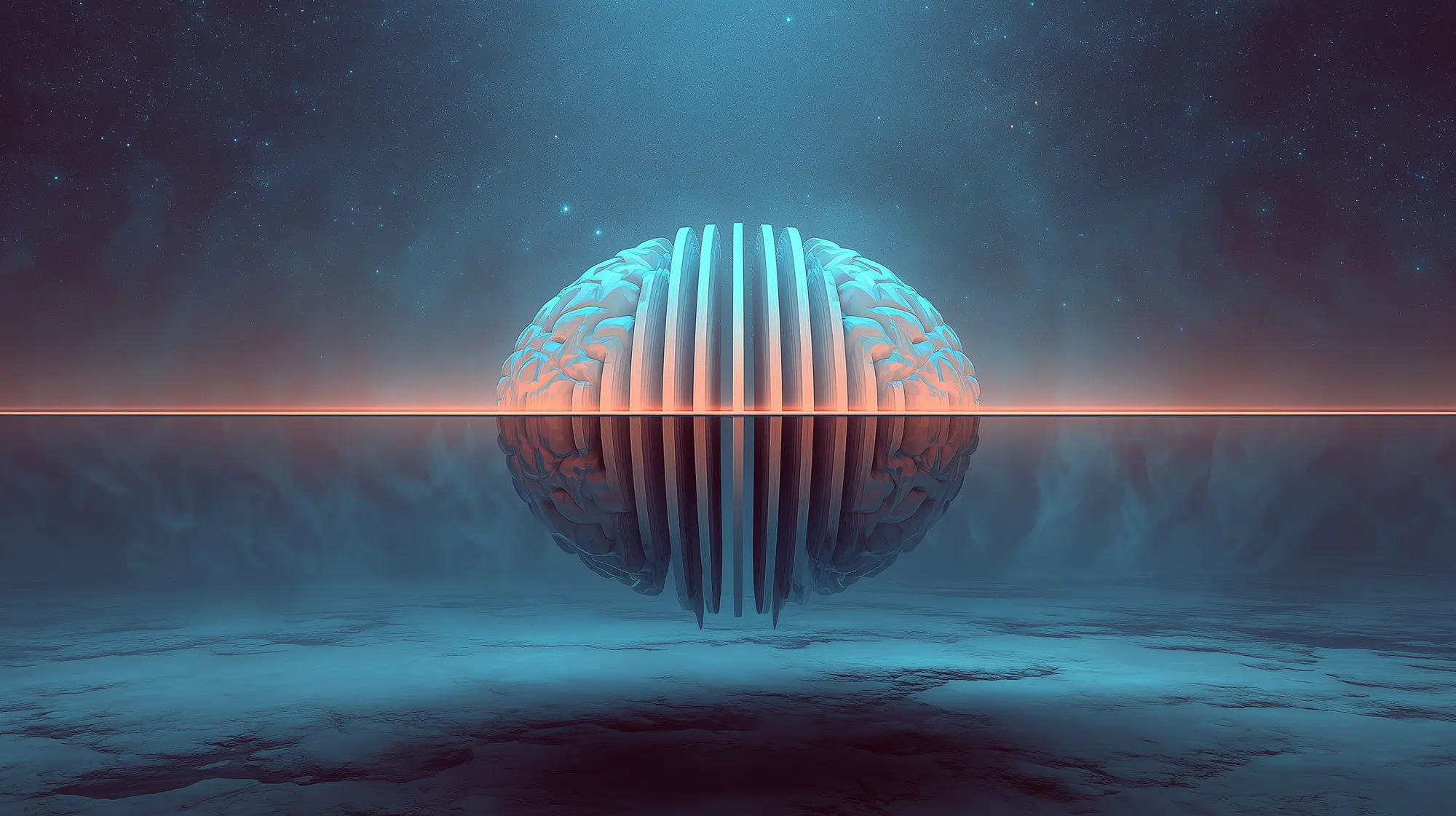
Then I read about this Kentucky psychic from the early 1900s (1877-1945). Edgar Cayce was A Bible-believing Christian, enthusiastic photographer, and family man, humble to a fault. But he was also gifted with a capability to tap into something incredibly unique. He gave over 14,000 medical readings between 1910 and 1944, now preserved in the Association for Research and Enlightenment archives.6
The readings worked like this: Someone would give Cayce a name and location. He'd enter a trance within moments while laying on a sofa in his study. Then he'd diagnose conditions accurately (often from hundreds of miles away)—describing abdominal adhesions, spinal lesions, circulatory issues with specificity that shouldn't be possible without modern imaging. He recommended treatments. Patients followed them. Outcomes were measured. He described molecular biology decades before the science existed. (Ready my post on The Sunday School Teacher Who Went Psychic)
The transcription dates are verifiable. The stenographer was a court reporter trained in accuracy. The medical outcomes are documented. Nothing about it works according to the model I inherited.
Aside from the medical readings, he also provided details in topics of consciousness, reincarnation, and the soul's purpose.
And that's when I stopped seeking permission and started looking higher up the ladder for more.
If consciousness is more than brain waves, if there's something beyond materialism's explanation, surely someone with credentials has investigated. They have.
Ian Stevenson at the University of Virginia School of Medicine documented 2,500 cases of children reporting verifiable past-life memories between 1967 and 2007.7 The Division of Perceptual Studies—housed within UVA's medical school—continues his work with systematic methodology, published findings, and rigorous case investigation. Children reporting names, locations, and details later verified through birth records, death certificates, and family interviews.
The International Association for Near-Death Studies8 has compiled peer-reviewed research on NDEs with accurate details reported from impossible perspectives. Patients describing surgical procedures while clinically dead. Observations of events in other rooms later confirmed by hospital staff. Sam Parnia's AWARE studies at NYU. Pim van Lommel's cardiac arrest research published in The Lancet.
The Parapsychological Association9—an affiliate of the American Association for the Advancement of Science since 1969—has replicated telepathy experiments with statistically significant results. The Society for Psychical Research's Psi Encyclopedia10 documents remote viewing research studied for decades with peer-reviewed methodology.
The Center for Consciousness Studies at the University of Arizona11 hosts the world's longest-running interdisciplinary conference on consciousness science, bringing together neuroscientists, physicists, philosophers, and researchers to address what they call "the hard problem." How does subjective experience emerge from physical processes? And what if it doesn't?
Across independent institutions. Different methodologies. Decades of research. The pattern holds.
The gap between "Stevenson documented 2,500 cases at UVA" and "reincarnation is proven" is sizeable. The gap between "Johns Hopkins ran controlled trials" and "consciousness exists independently of the brain" is as well. The delta between "patients report accurate observations during cardiac arrest" and "the soul survives death" gets even wider.
I don't dismiss those gaps. They're reasonable places to pause, and where a lot of scientists do.
But the compelling thing to me is the pattern across independent institutions, methodologies, and decades keeps pointing in the same direction. Something is happening that materialism doesn't account for. Something about consciousness that a purely physical explanation struggles to address.
So what have we learned about consciousness? Where does it come from? And what does that mean for us?
Most people want to know: Do these phenomena prove consciousness survives death?
I'm more interested in: What do they tell us about consciousness itself? Right now, not just after death.
Is it fundamental rather than emergent? Does it precede matter rather than result from it? Is the brain a receiver or filter rather than a generator? If you remove the interference—the ego, the doubt, the noise—does consciousness access information beyond the body's sensory limitations?
These aren't rhetorical questions. They're the ones I can't stop reading about, can't stop trying to understand. And I'm finding more and more I'm not alone in that.
If consciousness is fundamental—if it's the program rather than the output, the field rather than the signal—then creationism and materialism are both focusing on the wrong questions.
The church teaches us our physical bodies are temporary (yet also a sacred temple), and our souls are what matter after Earth, and we require institutional mediation for guidance and access to the divine.
Materialism teaches that we're meat and neurons with no meaning beyond biochemistry. Consciousness is an accident of evolution, and death is the end of experience.
The pattern in this research suggests something else: I - We are all part of a larger conscious system. These bodies might be temporary instruments, but consciousness itself appears to be something larger than biology. Something capable of accessing information and energy beyond sensory input. Something connected to everything else through mechanisms we're only beginning to understand.
One of those models makes us small and broken. One makes us inconsequential. The third makes us enormously powerful and connected.
I'm still figuring out the difference and truth between the three. But I know which one feels right to be pursuing today.

Details from citations from above can be clicked for more info