
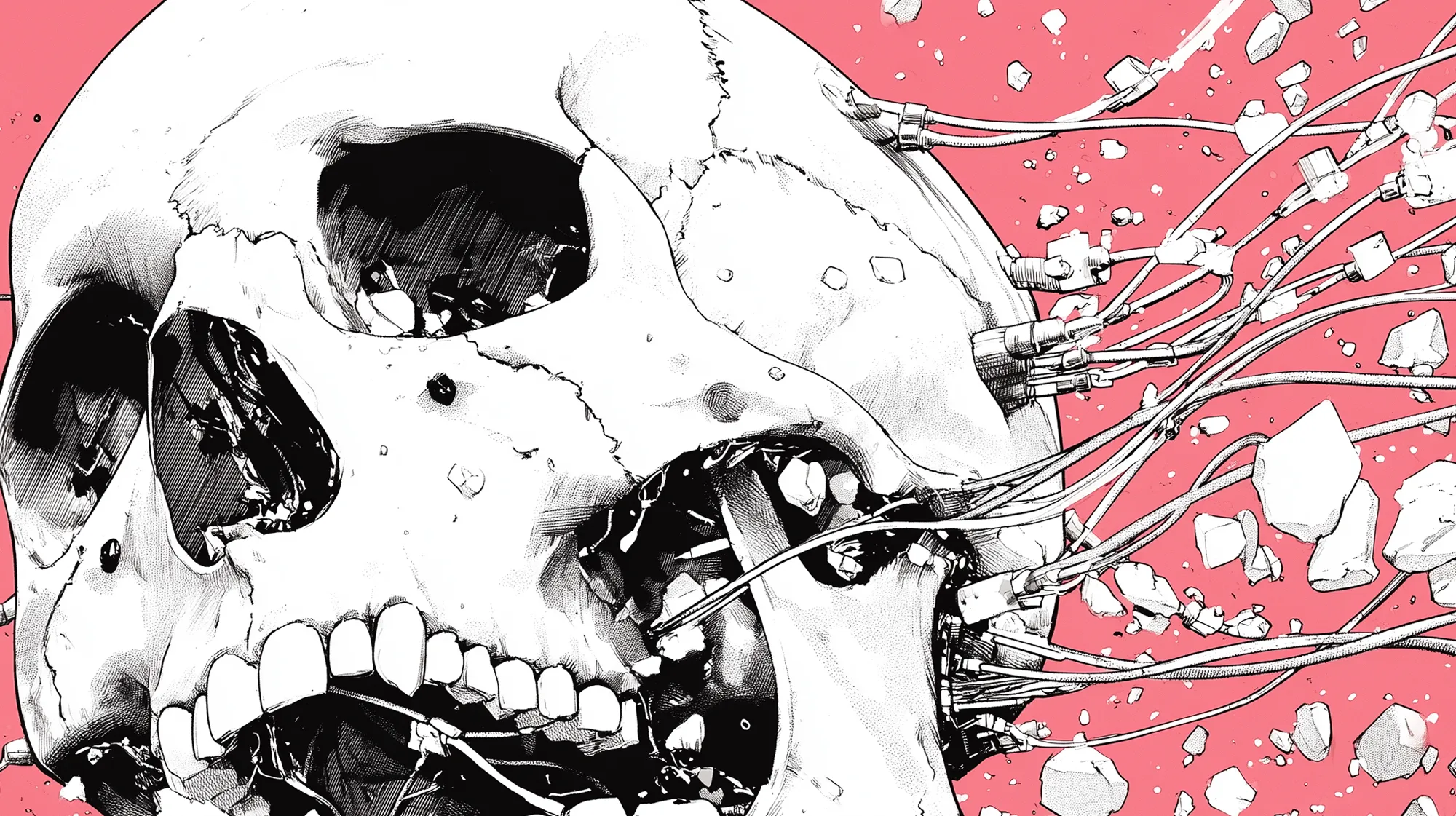
They Called It a Gateway
In 1984, a woman named Patricia Pulling founded an organization called BADD — Bothered About Dungeons & Dragons — after attributing her son’s suicide to the game. Within a few years, the campaign had reached Congress, local school boards, and Sunday morning sermons across the Midwest.
I never played Dungeons & Dragons. I was immersed in all things sports all the time. I can’t say I was legitimately interested in it. Some kids at school played and talked about it, and I kept a clear line of separation between myself and that topic.
What’s worth noting is that nobody had to enforce that line. I maintained it myself.
That’s not a story about good parenting or strong faith. That’s a story about a system working as designed. The Satanic Panic — documented across 67 community rumors by sociologist Jeffrey Victor,1 investigated by the National Center on Child Abuse and Neglect across approximately 12,000 ritual abuse accusations between 1980 and 19902 — didn’t operate through prohibition. It operated through internalization. The fear wasn’t imposed from outside. It was installed.
And once installed, it was indistinguishable from conviction.
I couldn’t have told you the difference at the time. Fear of the unknown. Fear of the devil. Fear of hell. Fear of God. The system had a name for that feeling: spiritual sensitivity. The closer you walked with God, the more you could sense what was dangerous. Self-policing wasn’t anxiety. It was discernment.
I spent years not knowing those were two different things.
The National Center on Child Abuse and Neglect found zero substantiated reports of the organized satanic rings driving the panic.2 Zero. The fear was manufactured from nothing. What wasn’t manufactured was its psychological residue. The black-and-white thinking, the external locus of control where knowledge is revealed rather than discovered, the instilled understanding that your own curiosity was a liability.
That residue didn’t stay in the 1980s.
PRRI data shows that Americans now aged 42–48 — the cohort raised during peak Satanic Panic, purity culture, and megachurch Christianity — experienced the largest increase in religious disaffiliation of any age bracket between 2013 and 2023. Eleven percentage points.3 The General Social Survey also points out that earlier generations reliably returned to church in their 30s and 40s.4 This cohort—my cohort—isn’t coming back.
The generation trained to fear its own curiosity became the cohort most statistically likely to walk away.
The question worth asking isn’t why they left. The research is fairly clear on that. The more interesting question is what the arc looks like — from the inside, across a generation, in the people who are still walking.
Five Streams, One Cohort
This piece isn’t going to tell you that me and my dear Xennials are special. That’s the trap. Every generation eventually decides its timing was uniquely consequential, and the academic establishment has grown appropriately skeptical of the whole enterprise. The National Academies of Sciences concluded in 2020 that generational categories “contribute to bias, stereotyping, and possibly age discrimination” more than to understanding.5 Pew Research Center announced in 2023 it would significantly scale back generational analysis.6
They’re not wrong to be cautious.
My intent with this post is to do something different. I’ll map five independent research streams — cognitive neuroscience, religious trauma psychology, demographic survey data, clinical psychiatry, and cultural sociology — none of which were designed to study each other, and show where they converge. Not because convergence proves anything. Because the pattern is too consistent to ignore and too under-documented to dismiss.
The direct empirical evidence for Xennial distinctiveness is thin. Only one peer-reviewed paper has studied the cohort by name.7 The sociologist most associated with popularizing the concept, Dan Woodman at the University of Melbourne, was careful to say there “isn’t yet any strong academic evidence for the grouping.”8 The unified arc — from authoritarian evangelical upbringing through deconstruction through alternative spiritual seeking — has not been studied as a model. Each segment is documented. The synthesis is original.
That honesty matters here, because the audience this piece is written for has already had one belief system that claimed more certainty than the evidence warranted. We’re not doing that again.
The evidence does show that adolescence is a critical period for brain development, and this cohort’s adolescence coincided precisely with the analog-to-digital revolution. The psychological harms of high-control evangelical environments are increasingly documented in peer-reviewed literature. American religious disaffiliation is accelerating, and this cohort is at its epicenter. The SBNR movement — Spiritual But Not Religious — now represents 22% of Americans, and 58% of them are under 50.9
Five streams. One cohort. No single study connecting them.
That gap is actually the argument.
I grew up evangelical in the 1980s Midwest. I went through the full arc — went from the evangelical framework for materialism, found both too small, and ended up somewhere neither would have predicted. For a long time I understood that as a personal story. Something that happened to me.
The research suggests it may be something that happened to a generation. And that the people living it — still somewhere in the middle of the walk — don’t yet have a framework for what the journey actually was.
This is an attempt at one.
What the Digital Revolution Did to Our Brains
Adolescence is now recognized as a critical period for brain development — a window during which environmental experience doesn’t just shape behavior, it shapes architecture. Permanently.
Those born between 1977–1983 experienced adolescence from roughly 1990 to 2000. The internet arrived dead in the middle of it.
We spent our entire childhoods reading on paper. The neural circuitry for sustained attention, analogical reasoning, and deep reflection had been built over years of practice on a medium that required it. Then, during the exact window when our brains were still malleable and being permanently shaped by what they practiced, a second mode arrived.
UCLA researcher Maryanne Wolf calls this the biliterate brain — the specific outcome of developing deep-reading circuitry first, then acquiring digital fluency while neurological plasticity was still open.10 Her research demonstrates that paper reading builds neural pathways screen reading doesn’t equivalently produce. A 2018 meta-analysis of 171,055 participants confirmed the paper comprehension advantage has actually increased since 2000.11
The experiment — whether this cohort retained both cognitive modes in a measurable way — has not been run in a neuroimaging lab. The hypothesis is testable. No one has tested it.
What has been documented: people born in generational cusp years are significantly less likely to self-identify with either adjacent label.12 Not special. Just genuinely between. Fluent in two worlds, belonging fully to neither.
Georg Simmel described this position in 1908.13 He called it the Stranger — not the person who passes through, but the one who comes today and stays tomorrow. Present but not absorbed. Near but not inside. Holding two vantage points simultaneously, seeing what people embedded in either world cannot.
He was writing about social position. The research suggests the same dynamic may have been written into the architecture of these particular brains.
What We Were Given to Carry
True Love Waits launched in 1993. Joshua Harris published I Kissed Dating Goodbye in 1997. Purity rings. Purity balls. The explicit theological framework that your body was a temple, your sexuality a liability, and your worth was contingent on what you hadn’t done yet.
We were 14 to 20 years old for all of it.
This wasn’t background noise. It was the water. Peer-reviewed research published in the Journal of Psychology and Theology documented correlations between purity culture beliefs and rape myth acceptance.14 Clinical reviews in peer-reviewed literature found that purity teachings created measurable physical, emotional, and sexual dysfunction.15 A 2017 study in the Journal of Adolescent Health found purity pledges associated with higher rates of HPV and nonmarital pregnancies — the precise outcomes the framework claimed to prevent.16
The megachurch was the delivery mechanism. Wellman, Corcoran, and Stockly’s High on God, published by Oxford University Press in 2020, documented how charismatic institutional bonds form and what happens when they break.17 They break. Mars Hill collapsed in 2014 with 12,000 weekly attendees. Ravi Zacharias, one of evangelical Christianity’s most prominent apologists, had his sexual misconduct confirmed posthumously in 2021. The Southern Baptist Convention’s systemic cover-up of abuse was exposed in 2022. Gateway Church lost 17–19% of attendance in 2024 following its own reckoning.
The institutions failed. Loudly. Publicly. In sequence.
I watched some of it happen in real time — not from inside those specific congregations, but close enough. The What Happened to Mars Hill podcast18 and the Gangster Capitalism season on Jerry Falwell19 didn’t introduce me to institutional failure. They named a pattern I had already felt but couldn’t articulate. That’s what good investigative journalism does when the timing is right. It doesn’t change your mind. It confirms what your experience had already been trying to tell you.
What the research documents with less precision is the psychological residue of the environment itself, independent of any single scandal. Marlene Winell, a PhD from Penn State and the daughter of missionaries, coined the term Religious Trauma Syndrome in 2011 to describe a recognizable cluster: PTSD-adjacent symptoms produced not by a single event but by sustained immersion in a high-control religious system.20 It’s not in the DSM-5. Clinicians typically code it under PTSD or Complex PTSD while using the framework descriptively. A 2024 scoping review found the peer-reviewed base still thin — ten studies meeting inclusion criteria.21 The concept is ahead of the evidence.
What is well-evidenced is a 2016 study in Social Science Research which found religious disaffiliation carries the worst mental health outcomes, specifically for evangelical Protestants.22 Not Catholics. Not mainline Protestants. Evangelical. The intensity of the original attachment produces the intensity of the loss.
And this cohort attached intensely. Because they were taught to.
I don’t remember choosing to self-police my curiosity. I remember that the line between fear and conviction was invisible to me for a very long time. The system had a name for that feeling — spiritual sensitivity — and that name made the fear feel like a form of closeness to God rather than a response to threat.
It wasn’t until years later, moving through other faith systems, ancient practices, consciousness research, that themes started colliding and standing out. The kingdom is within. We are all connected. This world is not our home. Frameworks I had inherited as exclusively Christian claims kept appearing in completely independent traditions, older and less institutionalized, wearing different clothes.
That’s when the distinction started to clarify.
There’s a phrase I grew up hearing: “So-and-so has walked away from the Lord.” It was delivered as a verdict. Eternal condemnation, condensed into a single sentence. I processed it that way for years.
I understand it differently now. What it actually described, in most cases, was someone walking away from the institutionality of it all.
They might have been walking closer to (or at least toward) the truth.
Where The Xennials Went
We didn’t stop believing. We stopped belonging. We didn’t leave to pursue binges of depravity and selfish desired. We left because we’re drawn to virtue and kindness and empathy and character. Attributes that have been washed away in all the self preservation and disingenuous brand building the church is more interested in.
Pew Research’s 2025 Religious Landscape Study — 37,000 respondents — puts religiously unaffiliated Americans at 30%. Doubled from 16% in 2007.23 The General Social Survey documents something more specific: earlier generations reliably returned to church in their 30s and 40s. The life-cycle effect, researchers called it — people drift in young adulthood, settle back in when they have families and mortgages and something to stabilize. Post-1970s cohorts broke that pattern entirely. Late-1980s Millennials show continued decline at the 30–44 checkpoint. This is something never previously observed in the data.4
The more interesting question is where 30% of America actually landed.
Pew’s 2023 survey of 11,000 Americans found that 22% now identify explicitly as Spiritual But Not Religious. Seventy percent describe themselves as spiritual in some way. Among the explicitly SBNR: 89% believe people have a soul. Seventy-one percent believe spirits exist in nature. Twenty percent believe in God as described in the Bible. Two percent attend weekly services.9
They kept the interior. They left the institution. And 58% of them are under 50.
Alongside this demographic shift, something unexpected was happening in clinical psychiatry. MDMA-assisted therapy trials published in Nature Medicine — first in 2021, confirmed in 202324,25 — produced effect sizes that dwarfed conventional psychiatric treatment. In the confirmatory trial, 71.2% of participants no longer met the diagnostic criteria for PTSD after treatment, versus 47.6% on placebo. The patients enrolled had been living with severe, treatment-resistant PTSD for an average of 16 years.
The FDA declined to approve it in 2024, citing concerns about blinding methodology and expectancy effects.26 The results remain what they are.
What the Johns Hopkins psilocybin research added was a mechanism.27 Across multiple studies, the quality of the mystical experience during a psilocybin session turned out to be the strongest predictor of therapeutic outcome — more predictive than dose, more predictive than therapist, more predictive than prior history. People weren’t just getting relief. They were reporting a direct encounter with something larger than themselves, and that encounter was doing most of the clinical work.
For a cohort that was handed a framework for transcendence and then watched the institution built around it collapse — this matters. The experience they were promised inside the institution appears to be available outside it. Not through doctrine. Not through membership. Through consciousness itself.
That’s not a theological claim. It’s a finding from randomized controlled trials.
The SBNR movement and the psychedelic therapy research arrived independently, from completely different directions, and pointed at the same thing: the interior experience the institution claimed to mediate doesn’t require the institution.
The cohort that learned this the hard way is now 42 to 48 years old. Statistically over-represented among the unaffiliated. Drawn toward consciousness research, ancient practices, non-institutional spirituality.
Walking away from the church.
Walking somewhere.
The Stranger at the Table
The Xennial concept has cultural resonance and thin academic scaffolding. Dan Woodman, the sociologist most associated with popularizing it, was careful: “there isn’t yet any strong academic evidence for the grouping.”8 The National Academies of Sciences concluded in 2020 that generational categories contribute to bias and stereotyping more than to understanding.5 Pew announced in 2023 it would scale back generational analysis entirely.6
These are reasonable positions. Generational thinking usually involves pattern-matching that flatters the people doing the matching.
What survives the critique is narrower and more useful. A 2024 study in Socius found that people born in cusp years are significantly less likely to self-identify with either adjacent generational label — a parabolic pattern that held after controlling for demographics.12 Not a claim about destiny or specialness. A documented finding about identity ambiguity. The people in the middle don’t fully belong to either side.
Georg Simmel named this position in 1908.13 The Stranger — not the person who passes through, but the one who arrives and stays. Present but not absorbed. Carrying the perspective of an outsider while living an insider’s life. Able to see both worlds clearly precisely because they are not fully captured by either.
The Stranger is not a hero. Simmel was careful about that too. The position carries its own costs — belonging nowhere, trusted conditionally by both sides, perpetually translating between worlds that don’t share a language. The 2016 finding that evangelical disaffiliation produces the worst mental health outcomes of any denominational exit isn’t a footnote.22 It’s the toll the bridge position extracts.
There are esoteric frameworks that place this birth range at major cycle transitions — Western numerology, Western astrology, the Chinese zodiac each independently arrive at something similar. Three systems, one convergence. It’s noted here because some readers will find it meaningful, and because the pattern is at minimum culturally interesting.
What the evidence actually supports is more modest and more durable than any esoteric frame. Adolescent brains during the digital transition, religious formation during peak evangelical culture-war Christianity, young adulthood during institutional collapse. This cohort—my cohort—was positioned to experience a set of collisions no adjacent cohort experienced in the same sequence.
Not chosen. Not special. Just there, at the intersection, when the lights changed.
The Bridge Broke in Both Directions
If you grew up evangelical in the 1980s and find yourself somewhere your past self wouldn’t recognize, the research doesn’t validate where you’ve landed. It documents the forces that made the journey structurally likely.
Because the dominant narrative for people on this arc has been personal. “You lost your faith.” “You walked away.” “You couldn’t hack it, or you got hurt, or you asked too many questions, or you were never really in to begin with...” The story gets told as individual failure or individual courage depending on who’s telling it — but either way, it’s about you specifically. Your weakness or your bravery. Your doubt or your discernment.
The research suggests the story was never only personal.
The Satanic Panic was a documented social phenomenon, not a parenting style.1,2 Purity culture was a coordinated institutional movement, not a family’s private values.14,15,16 The megachurch scandals were systemic, not isolated.17 The disaffiliation surge is demographic, not individual.3,4,23 The adolescent brain during the digital transition was shaped by timing, not character.10,11 Each collision that felt private turns out to have been shared — by a cohort, by a moment, by the particular intersection of forces that made the 1980s and 1990s what they were for children raised inside high-control evangelical Christianity.
What looked like personal disorientation was structurally produced.
That doesn’t dissolve the pain. The 2016 finding that evangelical disaffiliation carries the worst mental health outcomes of any denominational exit is not abstract22 — it’s the cost of having attached deeply to something that then failed you, or that you outgrew, or both. The bridge position is genuinely hard. Belonging nowhere is genuinely hard. Navigating two worlds that don’t share a language is tough.
I spent years processing my own arc as something that happened to me — individually, privately, because of something specific to my particular history. Then the themes started colliding. Ancient frameworks. Consciousness research. The kingdom within. We are all connected. Concepts I had inherited as exclusive property of one institution kept appearing everywhere I looked, older and less managed, in traditions that had survived without an enforcement mechanism.
And I started to understand that what I had called walking away was something else entirely.
The institution called it departure. The evidence suggests it might be direction.
If You Want to Go Deeper
The claims in this piece are verifiable. Here’s where to start.
On disaffiliation demographics: PRRI’s Religious Landscape Studies are free and searchable at prri.org. Pew Research’s General Social Survey analysis is available at pewresearch.org. Look for the birth-cohort breakdowns specifically — the generational return pattern, and where it breaks.
On the reading brain and adolescent neuroscience: Maryanne Wolf’s Reader, Come Home (2018) is the most accessible entry point into the biliterate brain research. Her earlier Proust and the Squid (2007) builds the foundational case. Both are written for general audiences.
On religious trauma: Marlene Winell’s work is collected at journeyfree.org. The peer-reviewed base is still developing — search “adverse religious and spiritual experiences” in PubMed for the most current clinical literature.
On psychedelic therapy: Mitchell et al.’s MAPP1 and MAPP2 trials were published in Nature Medicine in 2021 and 2023 respectively and are accessible through standard academic databases. Johns Hopkins Center for Psychedelic and Consciousness Research publishes ongoing findings at hopkinspsychedelic.org.
On the Stranger framework: Georg Simmel’s 1908 essay is public domain and widely available. It’s four pages. Worth reading in the original.
On the Satanic Panic: Jeffrey Victor’s Satanic Panic: The Creation of a Contemporary Legend (1993) remains the definitive academic treatment. The NCCCAN findings are cited within it.
On institutional collapse — investigative journalism: What Happened to Mars Hill (Christianity Today podcast, 2021). Gangster Capitalism Season 3: Liberty University (2021). The Hillsong documentary series (FX/Hulu, 2023) and the Discovery+ Carl Lentz documentary. None of these are academic sources. All of them do what good investigative journalism does — they make the pattern undeniable.