
Once we accept that consciousness is accessing something larger and defining our perception - the next question becomes unavoidable. What are we accessing? And why does it look like… this?

In 1899, Max Planck calculated the smallest measurable unit of space—roughly 1.6 × 10⁻³⁵ meters. Below this "Planck length", our two best theories of physics become incompatible with each other. We simply don't know what's happening down there.
It's now 125 years later, and we still don't. The question isn't whether the Planck length is an actual pixel of reality. It's whether information is more fundamental than matter. And that question is being taken seriously at serious institutions.
Princeton physicist John Wheeler1 proposed that information is the true foundation of physical reality. Not matter. He called it "it from bit." The idea is that physical phenomena emerge from binary information-processing rather than existing as independent material objects. MIT's Seth Lloyd2 went further, calculating that the universe can be described as performing computations on itself—51 million billion billion billion billion billion operations per second on 10⁹⁰ bits of information.
UC Irvine cognitive scientist Donald Hoffman3 arrived at a similar conclusion from a completely different direction. His interface theory of perception argues that our senses evolved to maximize survival, not accuracy. Like a computer UI simplifying complex code into icons, our perceptions show us what's useful for staying alive and reproducing—not what's actually there. Evolution shaped us to see "fitness payoffs" not objective reality.
It's ok to pause and read those again.
These aren't fringe theorists. These are physicists and cognitive scientists at major institutions asking whether the material world we experience might be a construct—a simplified interface for something more fundamental.
Philosophers and engineers are arriving at similar conclusions from different directions.
Philip Goff4 at Durham University makes the case for panpsychism, where consciousness is fundamental, not a byproduct of matter. Federico Faggin5 (he invented the microprocessor at Intel) has developed a formal theory proposing that quantum fields themselves are conscious. Consciousness as the substrate, with matter emerging from it. Not the other way around.
I came across Thomas Campbell6 through personal research—a physicist who spent years at the Monroe Institute studying altered states of consciousness. His "My Big TOE" - Theory Of Everything (unfortunate branding) proposes that physical reality is a virtual construct. I'm not saying Goff, Campbell, or any of the others are perfectly accurate. But what surprised me is how many credentialed researchers—from physics, cognitive science, philosophy, and engineering—are converging on similar questions.
As I took all this new evidence in, it became more interesting (and admittedly fun) to think about the material things we still can't explain with our current understanding. (Because we're discovering more of them)
I grew up taught that the great pyramids in Egypt were tombs for pharaohs. But it turns out pyramids aren't just in Egypt. They're in Mexico, Peru, China, Indonesia. The precision and standardization within individual traditions—lacking any documented contact—is striking.
The pyramids at Giza are aligned to true north within 3.4 arc-minutes.7 Cambridge Egyptologist Kate Spence demonstrated that the builders likely used circumpolar stars to achieve this precision—but the method requires sophisticated astronomical observation sustained over generations. The Great Pyramid's base covers 13 acres with sides equal to within inches. The ratios of its dimensions reflect pi and the golden ratio. Two narrow shafts inside point toward stars linked to Egyptian afterlife mythology, including those associated with Osiris.
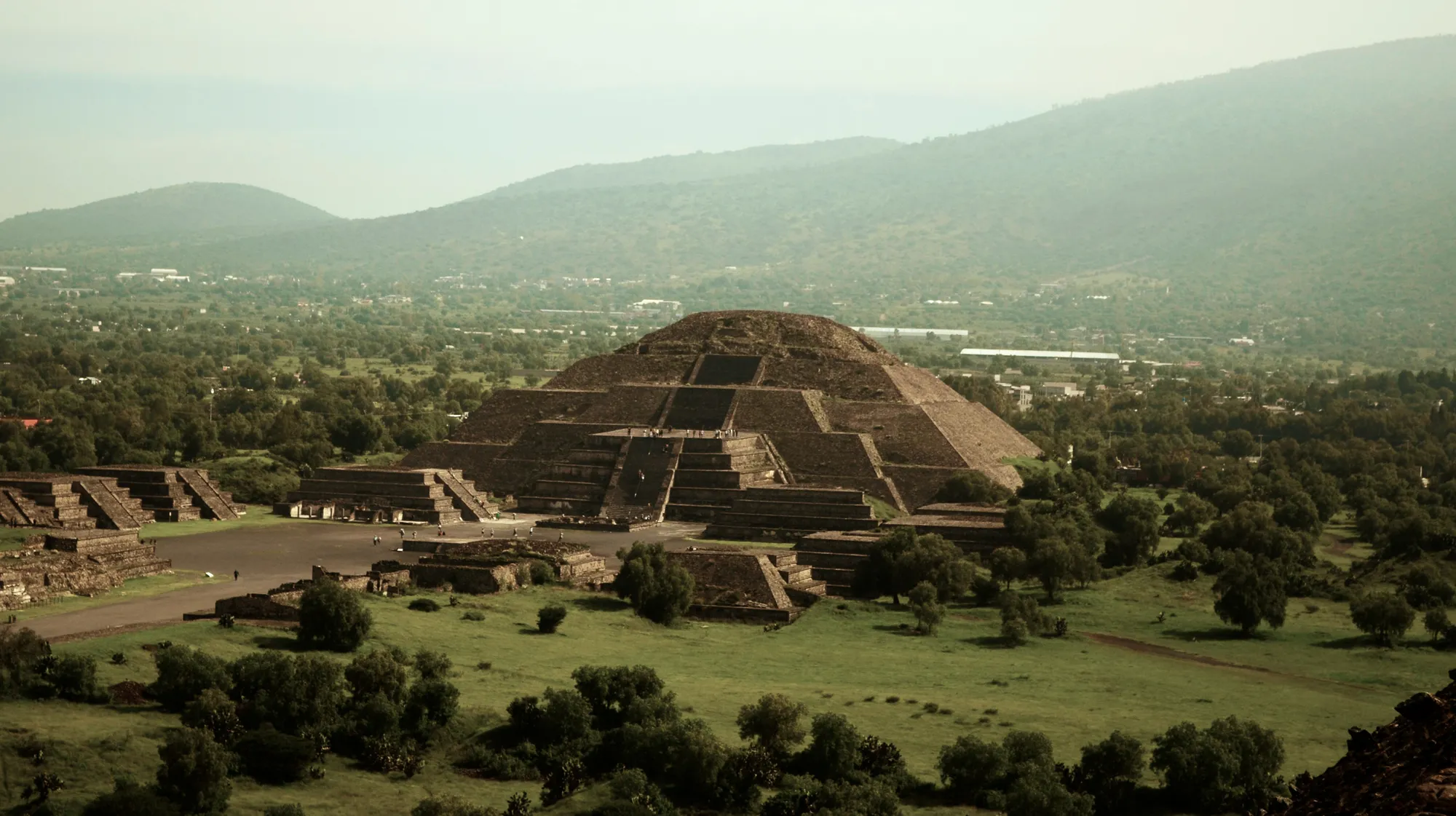
In Teotihuacan, Mexico, the Pyramid of the Sun is built on a cave system that aligns with specific astronomical events. ASU archaeologist Saburo Sugiyama8 demonstrated the entire city was laid out using a standardized 83-centimeter measurement unit applied with remarkable consistency—evidence of centralized planning and sophisticated metrology across multiple generations.
The engineering is extraordinary for civilizations working with the tools attributed to the period. Recent 3D metrology of predynastic Egyptian stone vessels reveals that some specimens achieve circularity within tens of microns—a level of geometric control that mainstream archaeology acknowledges but can't fully explain.
Archaeoastronomer Giulio Magli9 at Politecnico di Milano has found evidence that earlier cultures like Babylonian, Egyptian, and Vedic observed effects of the Precession of the Equinoxes over centuries of careful record-keeping. This 26,000-year cycle (during which Earth's axis completes a very slow "wobble") was first formally described by Hipparchus around 128 BCE. But indirect evidence suggests there was observation spanning multiple civilizations across millennia.
How many cycles did it take to discover, establish the pattern, and measure it effectively?
Mainstream archaeology documents extraordinary precision. The question isn't whether these structures are precise. It's how ancient cultures achieved it with the technology we attribute to them. And why was astronomy so important to them?
I can barely comprehend that I've come around on the idea of reincarnation. But here we are, after years of eye rolling at people discussing this very topic. It's funny what evidence does when you let it creep in.
Ian Stevenson at the University of Virginia School of Medicine10 documented 2,500 cases of children reporting verifiable past-life memories between 1967 and 2007. The Division of Perceptual Studies—housed within UVA's medical school—continues his work with systematic methodology, published findings, and rigorous case investigation. Children reporting names, locations, and details later verified through birth records, death certificates, and family interviews. This is peer-reviewed research at a major medical school. Documented cases with institutional verification.
Edgar Cayce's work11 also addresses reincarnation—roughly 2,000 of his 14,000 documented trance readings focused on past lives, including 700 describing Atlantean incarnations. But Cayce's readings (preserved in the Association for Research and Enlightenment archives) are unverified claims, not peer-reviewed research. They're compelling. They're part of what led me here. But they're not evidence in the way Stevenson's cases are evidence.
Nonetheless, this evidence of cycles is fascinating to examine along with things like the Precession of the Equinoxes and and The Younger Dryas impact hypothesis12 (It points to a cosmic event roughly 12,800 years ago that caused abrupt climate change and civilizational disruption. It's actively debated among geologists today.) Is it possible Earth has gone through planetary and civilization resets according to a cosmic calendar of sorts?
Probably not. But the pattern of cycling—in consciousness, in civilizations, in cosmic events—keeps appearing.
Just because quantum physics has a measurement problem doesn't mean that physical reality is virtual. Ancient structures showing extraordinary precision don't equate to " there were lost, advanced civilizations with technology we can't explain. The fact that Cayce's past life regressions included numerous Atlantean and Lemurian souls doesn't prove the existence of Atlantis.
But when physics, cognitive science, philosophy, and anomalous archaeology all point toward the same question—maybe physical reality isn't what it seems—I want to know more.
When the evidence suggests consciousness might be accessing something larger. When ancient cultures achieved precision we struggle to replicate. When children report verifiable past-life details. When physicists propose information precedes matter.
The pattern holds across independent disciplines, methodologies, decades of research.
At some point you hit the question: To what end? Why are we here, in this physical plane that is apparently not what it seems?
I've brought up our five senses a few times. I'm starting to understand them better as constraints and tethers in this realm. Because consciousness is free will, constraints are a necessary framework within which it can evolve. We experience consciousness differently as our brain grows and develops, as we go through puberty, as we suffer trauma, drink alcohol, take drugs. Over time, an increase in consciousness takes place. And some people experience far more growth than others.
But those five senses also tether us to the belief that the material world is our true nature. Keep us anchored in the dream. Each experience of pleasure or pain reinforces: seek control over every scenario and outcome. "As long as ___, then I can be OK."
In today's society, everyone's ___ is colliding with everyone else's and the world around them. The only answer we seem to come up with is that we need to exercise more control to get our ___. Both in identity groups and as individuals.
Some frameworks suggest something more intentional is happening. That there's a structure—call it a system, an architecture, a design—that benefits from keeping consciousness tethered to material reality. The Gnostic texts called it archons and the demiurge. Robert Monroe's work at the Monroe Institute explored what he termed "loosh"—emotional energy as a harvestable resource. Campbell's virtual reality framework suggests a purpose to physical constraints.
I'm not asking you to believe those frameworks. I don't know if I believe them. But they're attempts to answer a legitimate question: If physical reality is a construct and consciousness is fundamental, what's the purpose of the construct?
Think about any organization that lasts decades or centuries. Power consolidates at the top and protects itself. Everyone else becomes a resource to ensure the system keeps producing. Values become optional. Participation remains essential. Now imagine that concept over the span of eons.
Zoom out far enough, and certain patterns become visible. The majority of resources and power in the hands of very, very few. A state of constant chaos and calamity that generates distress and fear at scale.
I realize how this sounds. But take a step back and look at what's actually happening out there. Look at the alternatives people are believing, the results they're yielding, and the contentment they have with it. The moment we stop believing that we're the crazy one is so freeing.
If life on this physical plane is akin to a dream, then it has to be made real through perception. Distraction. Separation. Ritual. Practice. If consciousness is source and truth, then our awareness—not authority or possessions—is where real power lies.
Especially if you grew up in a faith tradition like me. I thought Western Christianity and modern science explained everything quite nicely. I spent 40 years inside that box, playing my role. But then a seam of light started to appear, and I realized this little box has a lid.
Details from citations from above can be clicked for more info